3. What Happens When the Market Turns?
Managing Exposure Without Selling Your Shares
Professional portfolio managers may use hedging to reduce exposure while retaining an investment. Hedge funds use many strategies, and not all involve hedging. The useful principle for an individual investor is learning to manage the risk of a position you still want to own.
A hedge is an opposing position intended to reduce the financial impact of an adverse move in another investment.
FlowDM uses selected inverse exchange-traded funds, or ETFs, and calibrates the opposing position to target near-neutral exposure. You retain your original bull holding while the inverse leg is designed to offset much of its subsequent movement.
The purpose is to manage exposure through a decline while staying in the position.
The Threshold You Choose
Let's return to the same hypothetical investment: 100 shares purchased at $100 each. The stock has advanced to $140, and you want to continue holding it.
You have chosen a protective threshold at $130. If the stock reaches that threshold, FlowDM attempts to establish the calibrated hedge.
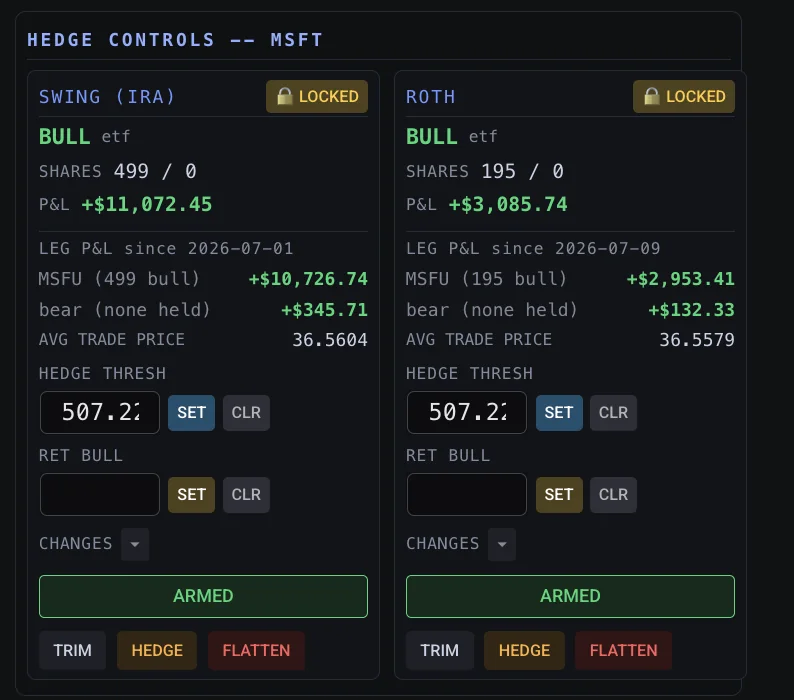
That $130 level is illustrative. In the FlowDM method, you look for dislocation or a compression range with tested absorption, seek an entry near the put wall, and generally place the threshold $2–$3 below that wall.
A put wall is a price level with concentrated open put-option positions; tested absorption means repeated evidence that buyers are absorbing selling around a price area.
You give the range room to develop rather than repeatedly toggling protection through normal price movement.
As a higher band establishes and tests support, you may raise the threshold beneath its put wall. A newly drawn higher wall alone does not require an adjustment. These are your decisions.
Thresholds use the underlying equity price, including when your bull position is an ETF.
What the Hedge Is Designed to Do
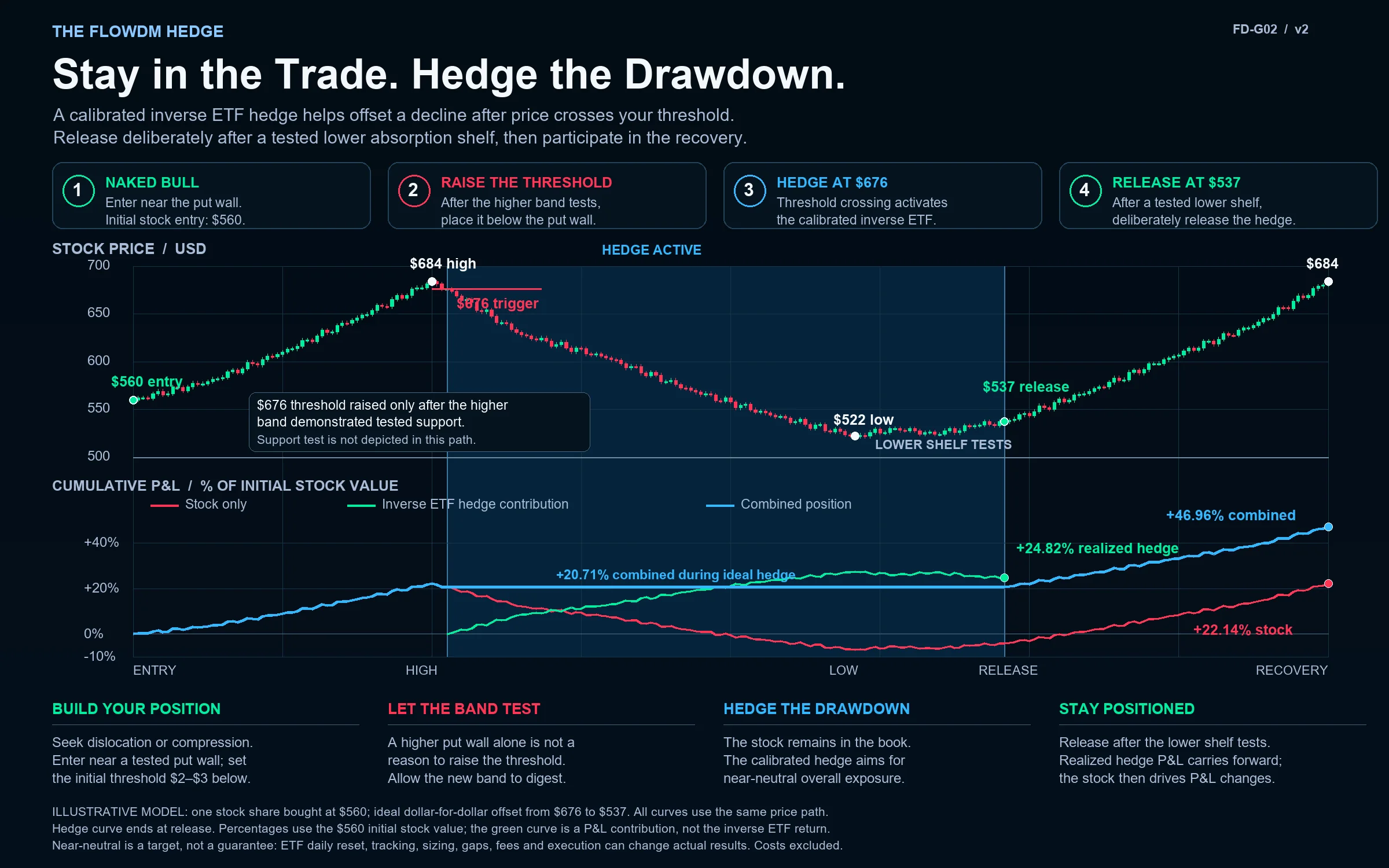
Assume the hedge activates near $130 and the stock continues down to $110. Your 100 shares lose another $2,000 in market value. Gains in the inverse leg are intended to offset much of that additional loss.
The hedge does not recover the $1,000 of unrealized gains given back between $140 and $130. It targets the movement after activation.
Near-neutral exposure is a target, not a guarantee. Execution, gaps, spreads, liquidity, tracking, and timing affect results. Inverse ETFs generally reset daily, so performance over several days can diverge from a simple inverse of the underlying's total move. A hedge can also offset gains if the stock reverses upward.
You still own the original shares. You are managing their exposure with a paired position.
The hedge illustration uses a separate, simplified Meta-inspired price path. Its prices are independent of the 100-share example above, and its modeled results are not an actual performance record.
What Happens Next?
Selling remains an available choice. If you retain the position, you continue evaluating the market and the stock's price structure.
When a new range develops with tested absorption and conditions support renewed bullish exposure, you decide whether to close the inverse leg. That restores full bullish exposure to the original holding; it is not an automatic response to a bounce.
The next chapter explains how a completed hedge may improve the economics of that continuing investment. No strategy guarantees a profit.
You choose the investment, the threshold, and the hedge release. FlowDM carries out the protection you configure.