A Different Way to Trade. A Different Way to Stay Invested.
The Stock Market Is About Owning Businesses
When people talk about Wall Street, the conversation often turns to speculation, gambling, and the daily drama of rising and falling stock prices.
Watch financial television or scroll through social media, and it's easy to come away thinking the stock market is little more than a game of predicting what happens next.
But beneath all that noise is something much simpler.
The stock market gives everyday people the opportunity to own pieces of real businesses.
Think about that for a moment.
You don't have to start a technology company to participate in its success. You can own part of one.
You don't need millions of dollars to invest in businesses whose products you use, whose leadership you admire, or whose future you believe in.
Someone working at a coffee shop can own shares in Apple, Microsoft, or Google. They can invest in several different companies, participate in their growth, and sell those shares when they choose.
And public markets help businesses raise the capital they need to expand, innovate, and create new opportunities.
That's one of the remarkable things about investing. It gives ordinary people the opportunity to participate in business ownership.
And it's why so many of us invest in the first place.
Owning a Great Company Doesn't Mean Its Stock Always Goes Up
You may believe in a company's products, its leadership, its earnings, and its long-term future.
But that doesn't mean its stock price will move in a straight line.
Markets go through periods of growth, uncertainty, consolidation, and sometimes significant declines.
A fundamentally strong company can experience a substantial drop in its share price without its underlying business suddenly becoming a bad investment.
Sometimes the broader market is selling off. Sometimes investors are moving money between sectors. And sometimes a stock is simply experiencing normal fluctuations as buyers and sellers establish its next trading range.
The challenge is knowing the difference.
Is your stock experiencing normal price movement, or is something more significant developing?
For many investors, that question becomes especially difficult when their own money is on the line.
Have You Ever Experienced This?
You research a company.
You believe in its future.
You buy the stock.
Then the price begins to fall.
At first, you're patient. But as the decline continues, uncertainty grows. Eventually, you sell because you're worried about losing more money.
Months later, the stock recovers.
Perhaps it even reaches new highs.
Your original investment idea may have been right, but you weren't able to stay with it through the decline.
Or perhaps you've experienced the opposite:
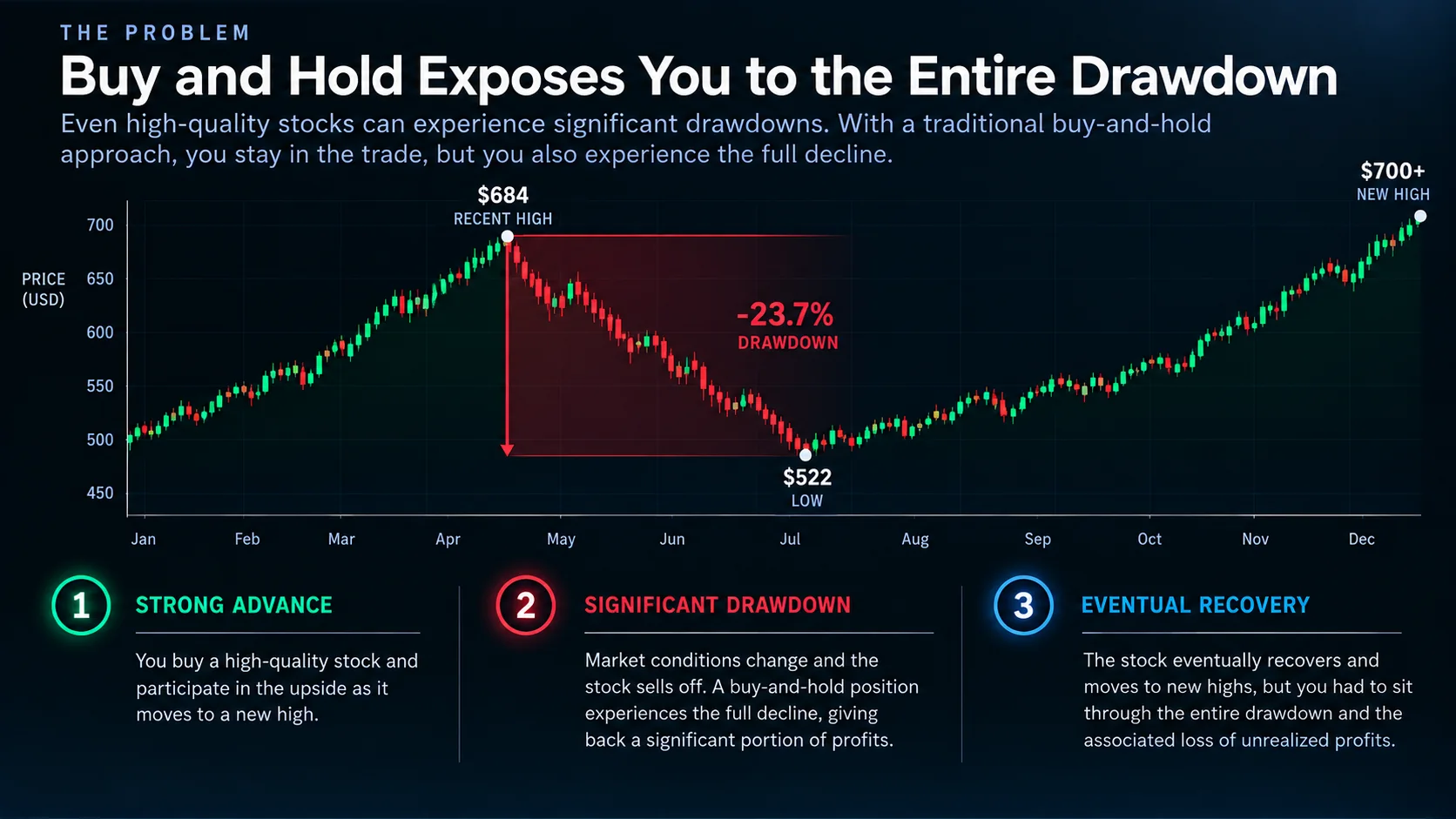
You buy a stock, it performs well, and you build a substantial unrealized gain.
Then the market turns.
You watch weeks or months of gains disappear while trying to decide whether to sell.
Finding a good investment is only part of the challenge. Managing what happens after you buy it is the other part.
And that's where a different approach becomes worth considering.
What If You Had Another Choice?
What if you believed in a company and wanted to continue owning it, even when market conditions turned against you?
What if you had a way to reduce your exposure to a significant decline without immediately selling your investment?
This is where we can learn something from how institutional portfolio managers approach the market.
You've probably heard the term hedge fund. These investment firms are known for using sophisticated strategies to manage capital, including techniques designed to reduce exposure when markets decline.
One of those techniques is hedging—establishing an opposing position that can help offset losses in an investment without requiring the investor to sell the original holding.
While hedge funds employ many different strategies, the underlying concept of managing exposure is something individual investors can learn from, too.
Professional investors don't always have to choose between holding a stock through a decline and selling it entirely.
Depending on their strategy, they may use hedging to reduce their exposure while maintaining their investment.
Hedging is simply a financial tool designed to offset some of the losses in an investment when its price moves against you.
It's not a prediction of success. Like any financial tool, its effectiveness depends on how and when it's used.
But it provides another choice.
What if individual traders and investors had access to a similar approach to managing their positions?
That's one of the central ideas behind FlowDM.
We've brought an institutional-style approach to position management into a terminal designed for self-directed retail traders and investors.
Rather than simply deciding when to buy or sell, you can also decide when to remain fully invested, when to protect your position, and when to remove that protection.
You're not trying to predict every market move.
You're learning to manage your exposure as market conditions change.
Introducing FlowDM
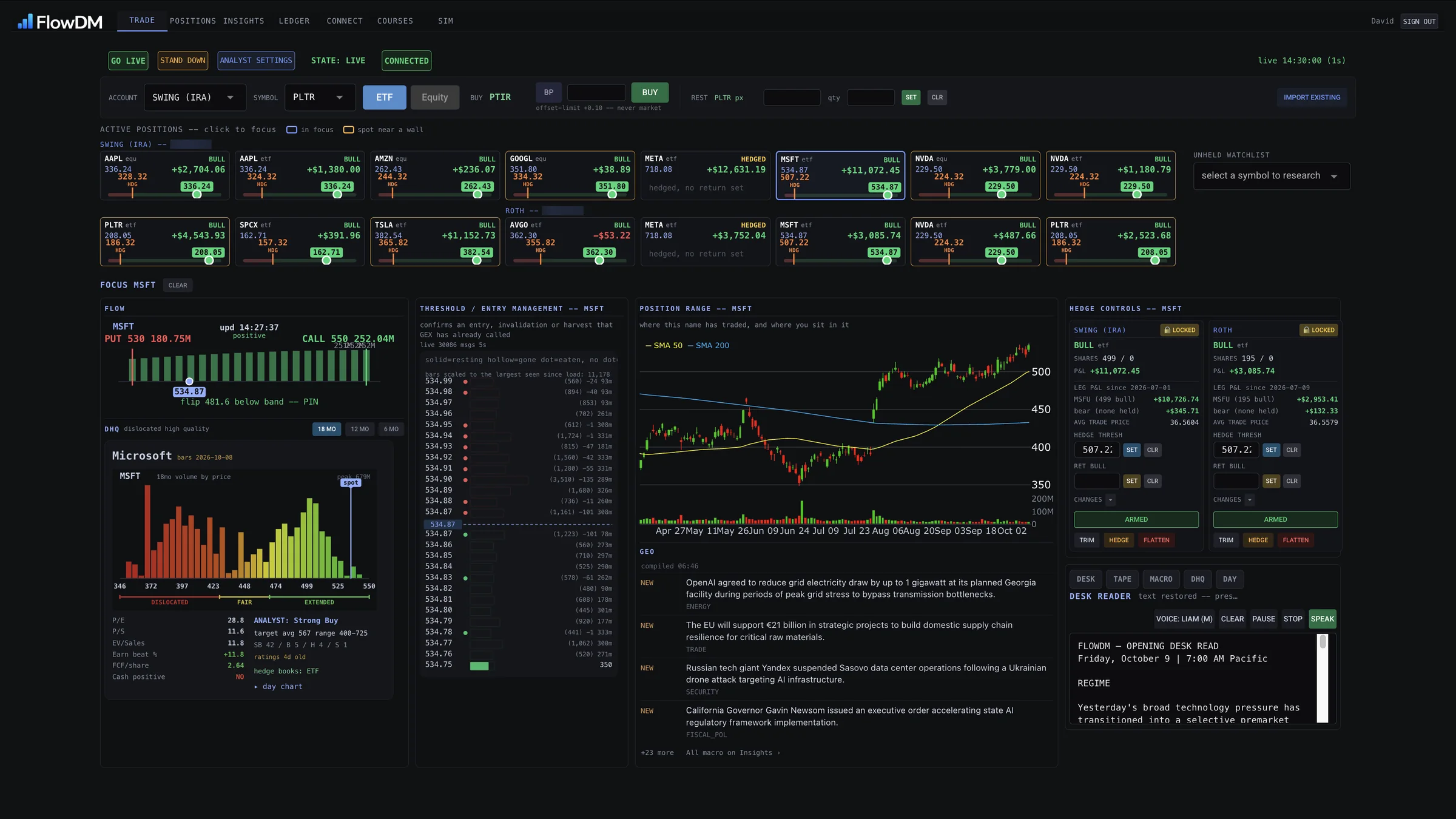
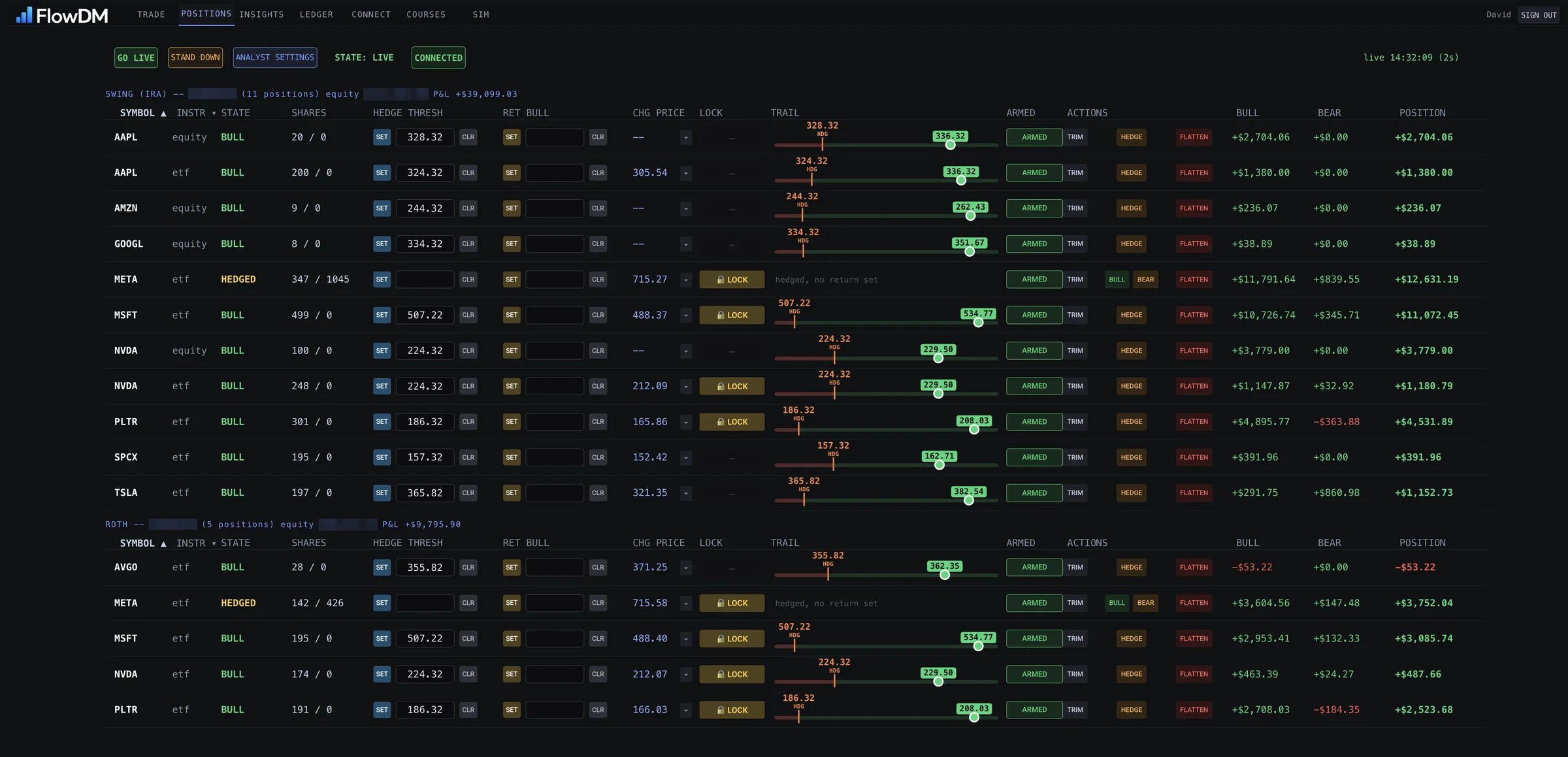
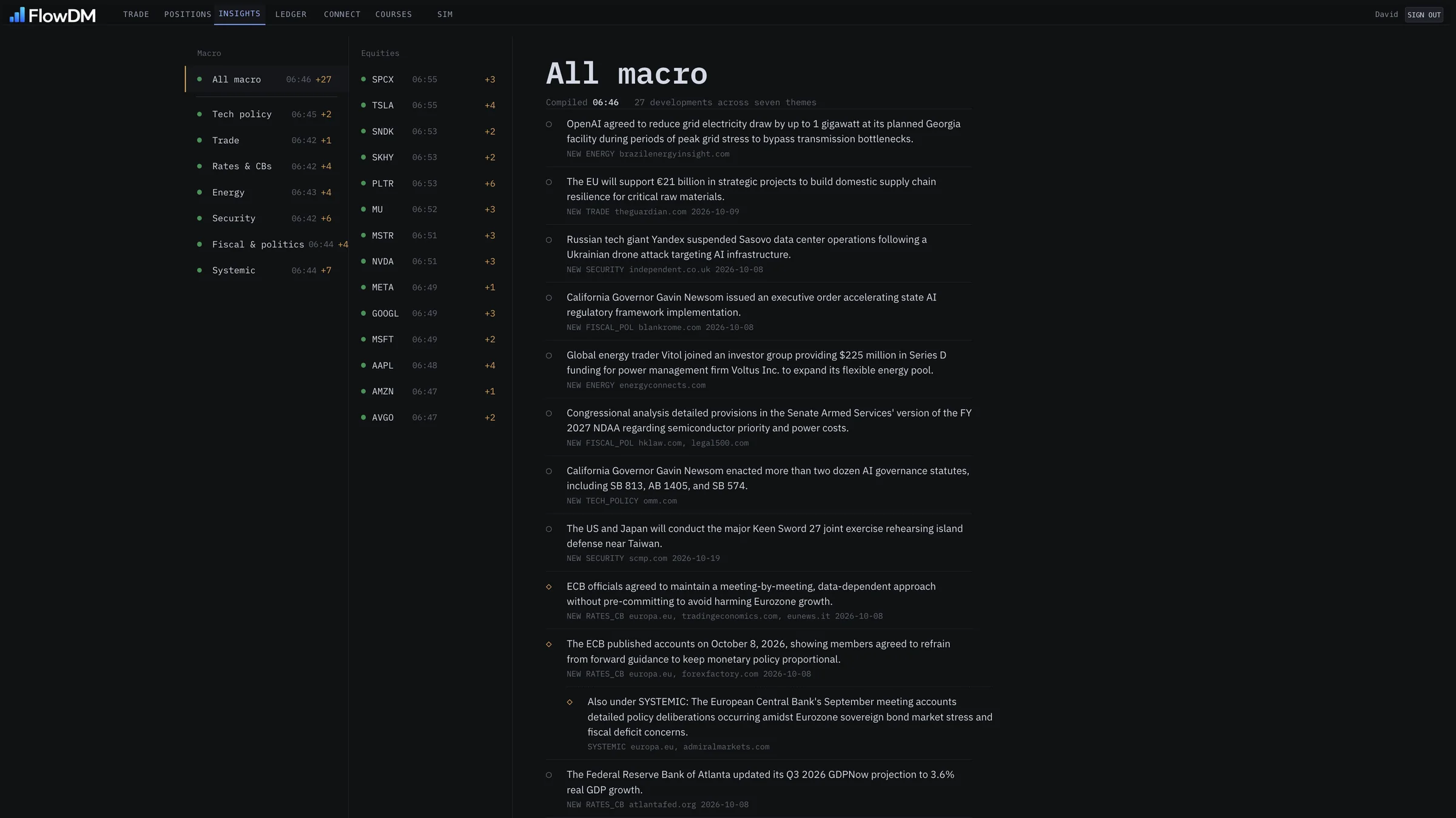
FlowDM is an institutional-style position-management terminal designed to help self-directed traders and investors understand market conditions, identify opportunities, and manage the positions they choose to own.
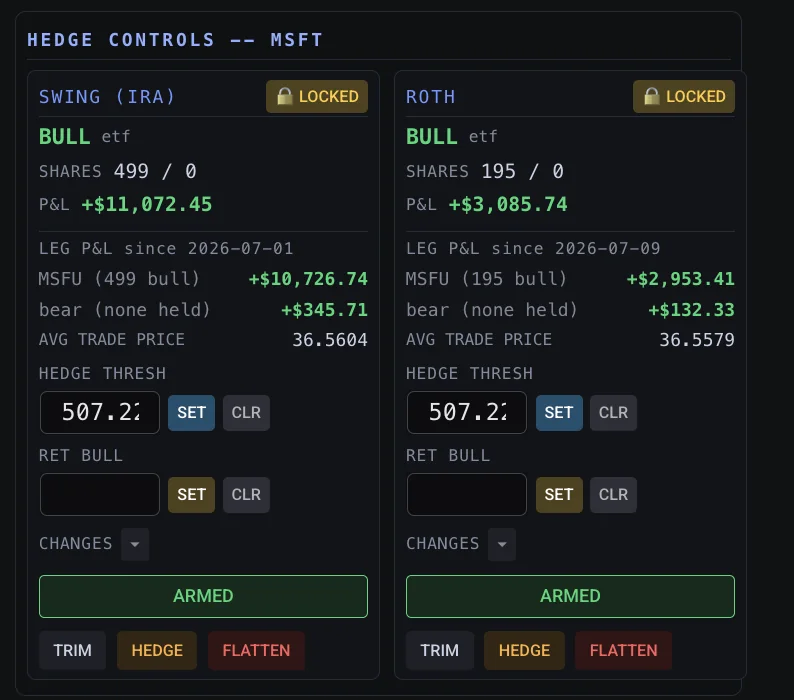
At the center of FlowDM is its hedge engine.
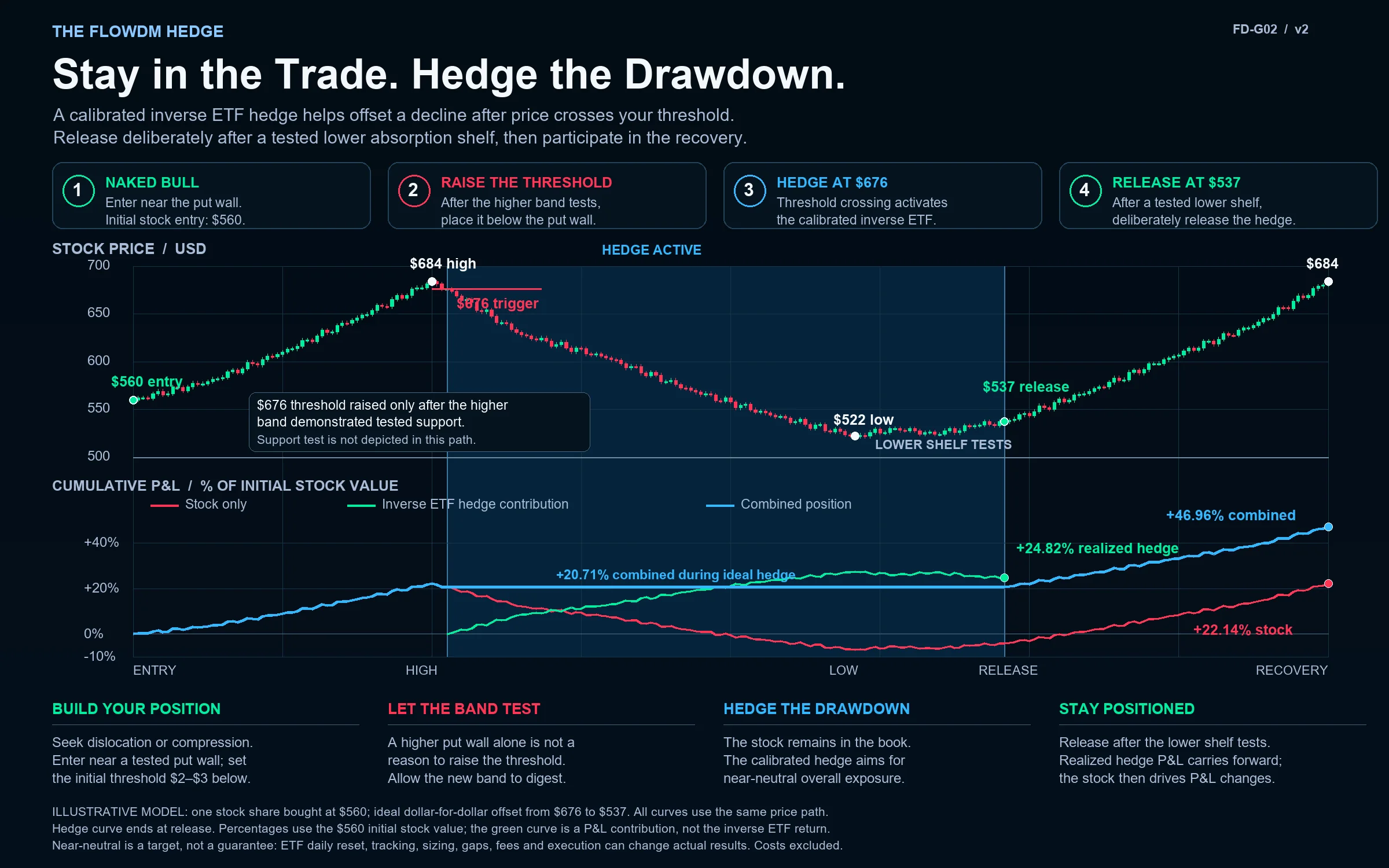
When you establish a position, you can choose a price level where you want protection to activate.
If the stock reaches that threshold, FlowDM is designed to establish an opposing position using a calibrated inverse exchange-traded fund.
The objective is to reduce your exposure to further declines while you continue holding your original investment.
The hedge is designed to bring the position closer to neutral, although actual results depend on market conditions, execution, and how closely the opposing positions offset each other.
And when the stock establishes a new trading range and conditions support another opportunity, you decide when to remove the hedge and regain your full bullish exposure.
You may even have an opportunity to improve the economics of your position by removing protection at a lower price.
Of course, stocks can reverse unexpectedly, hedges can miss subsequent upside, and no strategy guarantees a profitable outcome.
The important difference is that you now have another tool for managing the journey.
You don't automatically have to abandon a company you believe in simply because its stock enters a difficult period.
Who Is FlowDM For?
FlowDM is designed for self-directed traders and investors who want a more structured approach to managing their positions.
You might be an active trader who's grown tired of constantly entering and exiting positions. A swing trader looking for a better way to navigate market drawdowns. Or a long-term investor who believes in the companies they own but wants more control over downside exposure.
Whatever your experience, the underlying challenge is often the same: finding a good opportunity is one thing. Managing that position through changing market conditions is another.
FlowDM offers a different approach. Rather than trying to capture every market movement, it helps you focus on owning quality companies, managing exposure, and staying with a position when your strategy supports it.
You don't have to stop thinking like a trader. You can start managing your positions like a portfolio manager.
Think Like an Investor. Manage Like a Portfolio Manager.
Traditional investing advice often tells us not to try to time the market.
And there's wisdom in that.
Consistently predicting exactly when stocks will rise or fall is extraordinarily difficult.
But does that mean your only choice is to buy a stock and simply accept whatever happens next?
We believe there's another approach.
With FlowDM, you begin by thinking like an investor.
You identify companies you believe are worth owning. You look for attractive opportunities to establish positions. And you give those investments time to grow.
But you also take a more active role in managing those positions.
Sometimes the market is advancing, your protection is appropriately positioned, and there's very little you need to do.
Other times, a stock establishes a new trading range, broader market conditions change, or a significant decline begins to develop.
Those situations may call for a closer look at your positions and your protective thresholds.
You're not trying to predict every movement. You're learning when to give your investments room to grow and when changing conditions may call for protection.
This approach requires more involvement than traditional buy-and-hold investing.
But it doesn't mean you need to sit in front of a trading screen all day or constantly move in and out of positions.
The goal isn't to trade more. It's to manage better.
More Information Isn't Always the Answer
Today's traders have access to an extraordinary amount of market information.
Charts, indicators, signals, and alerts are everywhere.
But more information doesn't necessarily make managing your investments easier.
What matters is knowing what to look for, understanding what it means, and having a plan for what to do next.
FlowDM is built around that idea.
It's not simply another collection of trading indicators.
It's a position-management terminal that brings together market information, tools for evaluating opportunities, and a hedge engine designed to help you manage your positions as conditions change.
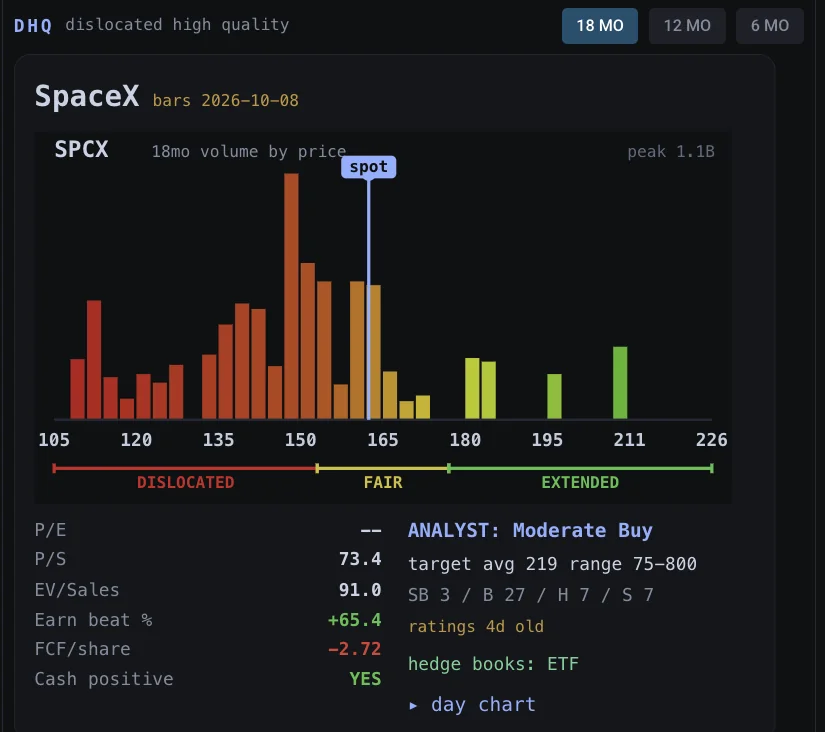
FlowDM helps you examine where a stock is trading relative to its history, identify important price levels, evaluate buying and selling activity, and understand the broader market environment.
It also helps you look beneath the stock price itself.
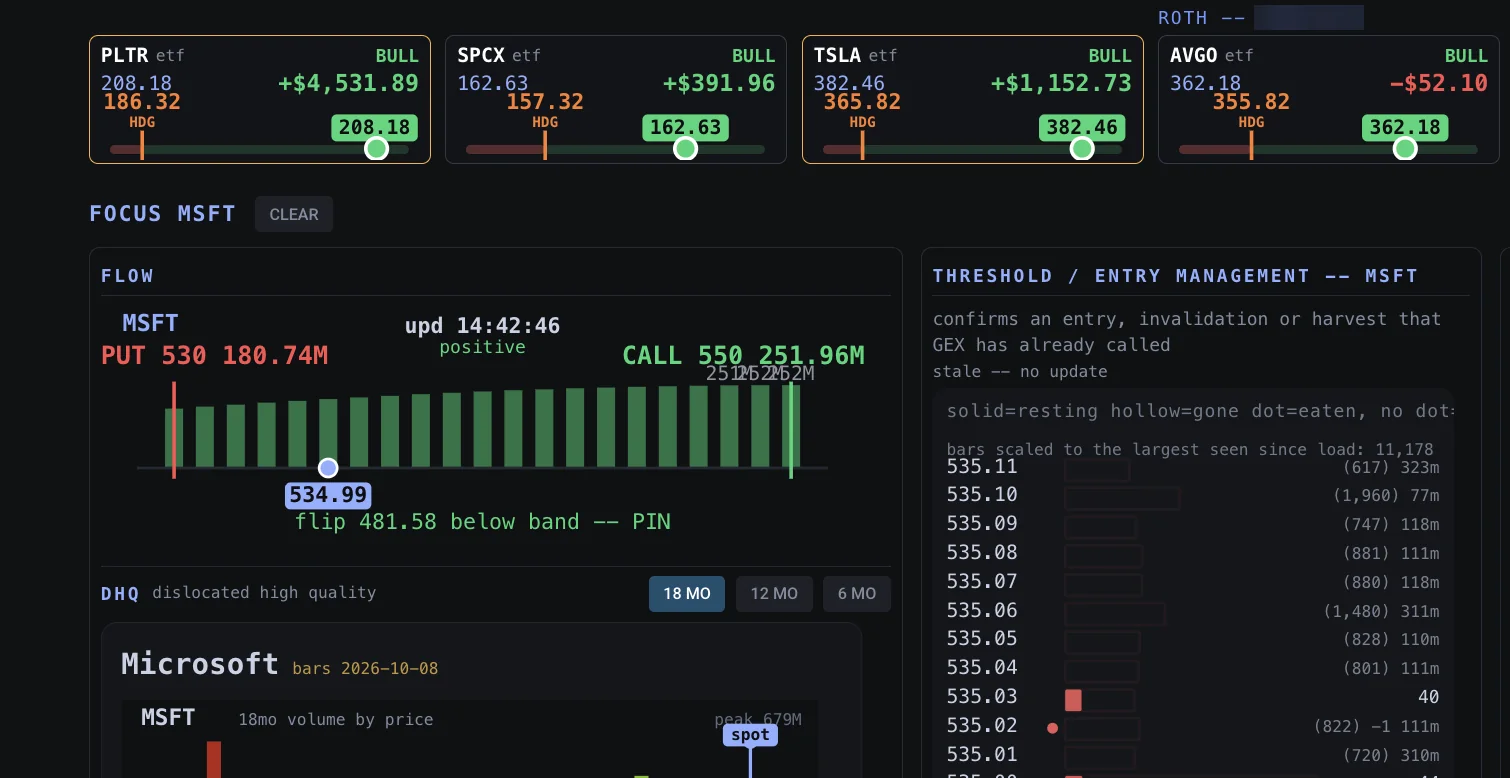
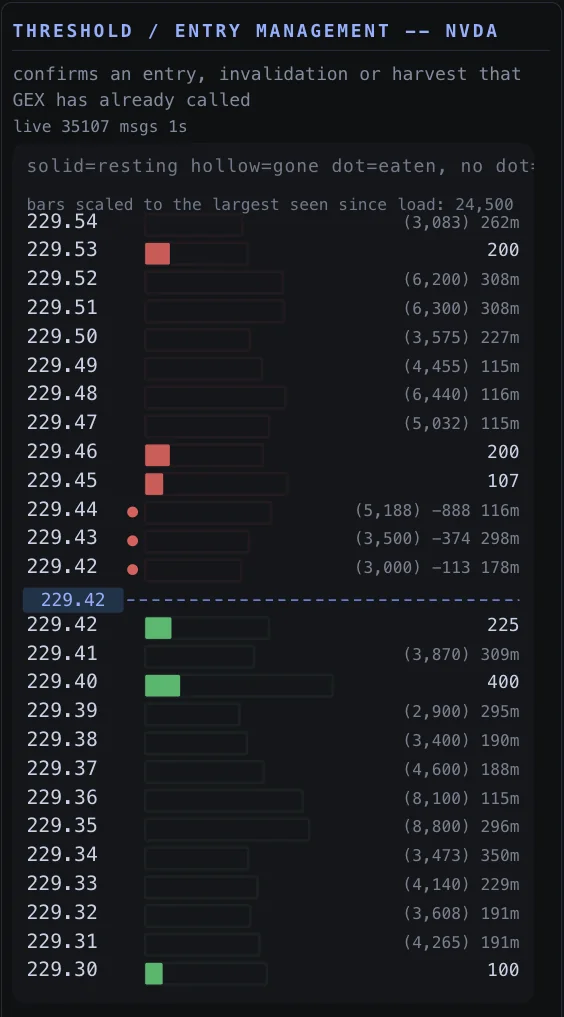
Through options positioning and market-flow indicators, you can explore where major options activity is concentrated, how market makers and options dealers may be positioned, and how their need to buy or sell shares to manage risk can influence stock prices.
These are market forces many individual investors have never been taught to examine. FlowDM brings that information into the same environment where you're managing your positions.
These tools can help you distinguish normal price movement from conditions that may warrant greater caution.
They don't predict the future. They provide information to support your decisions.
The indicators serve the strategy. The strategy doesn't serve the indicators.
That's what we mean by an institutional-style approach to retail trading.
It's not about having the most indicators.
It's about using the right information to manage your positions.
Hearing This for the First Time?
If you've mainly learned about markets through financial news, earnings, valuations, and chart patterns, some of these ideas may feel unfamiliar. You may be wondering: Is there another way to understand what moves prices—and manage an investment through those moves?
Explore that question for yourself. Copy our short question and paste it into the AI model you already use—ChatGPT, Claude, Gemini/Google, or another. Ask how professional trading desks approach markets compared with the methods commonly taught to individual investors, and see what you learn.
View question
Is there another way to see the market beyond what most retail traders are taught?

I've mostly learned to watch financial news, follow earnings and valuations, draw support and resistance lines, and look for candlestick patterns like head and shoulders—all to decide when to buy or sell.

Now I'm hearing that institutional trading desks use a different lens: buying and selling flows, liquidity, options positioning, dealer hedging, gamma exposure (GEX), relative volume, and connections between markets. They may manage exposure by hedging a position they still want to own rather than selling it during a decline.

Is this an established approach that receives less attention in mainstream retail trading education? How does it change the questions you ask about why a stock is moving—and what you do with a position you already own?

Explain the distinction clearly, using one simple hypothetical example. Keep it short and beginner-friendly, without treating every institution or retail trader as alike. Cite reliable sources where useful.
The FlowDM Method introduces that perspective one step at a time, connecting market conditions and evidence to your own decisions about managing a position.
Discover the FlowDM Method
We believe understanding the strategy should come before deciding whether to use the software.
That's why we've created a series of educational courses explaining the FlowDM approach, its technology, and the market mechanics behind it.
You can begin learning without creating an account, providing an email address, or entering payment information.
Start with The FlowDM Method, our complete introductory course, available free to everyone.
Then explore our additional courses, review their tables of contents, and experience the opening chapters before deciding whether a FlowDM subscription is right for you.
Whether you're an experienced trader or someone looking for a more active approach to managing investments, our goal is to help you understand what FlowDM offers and how its tools are intended to work.
A Different Way to Trade. A Different Way to Stay Invested.
Think Like an Investor. Manage Like a Portfolio Manager.