4. The Opportunity in Repricing
A Decline Doesn't Always Mean the Opportunity Is Over
In our hypothetical example, you bought 100 shares at $100. The stock advanced to $140, your hedge activated near $130, and the stock subsequently declined to $110.
You still hold the original shares. The hedge was designed to reduce the impact of the decline after activation.
Now suppose the stock settles into a lower trading range. Buyers repeatedly appear, selling is absorbed, and the range begins demonstrating support. This is an absorption shelf: an area where buying has repeatedly absorbed selling pressure.
You may decide that the evidence supports a return to full bullish exposure.
What Does Repricing Mean?
Repricing means using a new price opportunity to improve the economics of your continuing position.
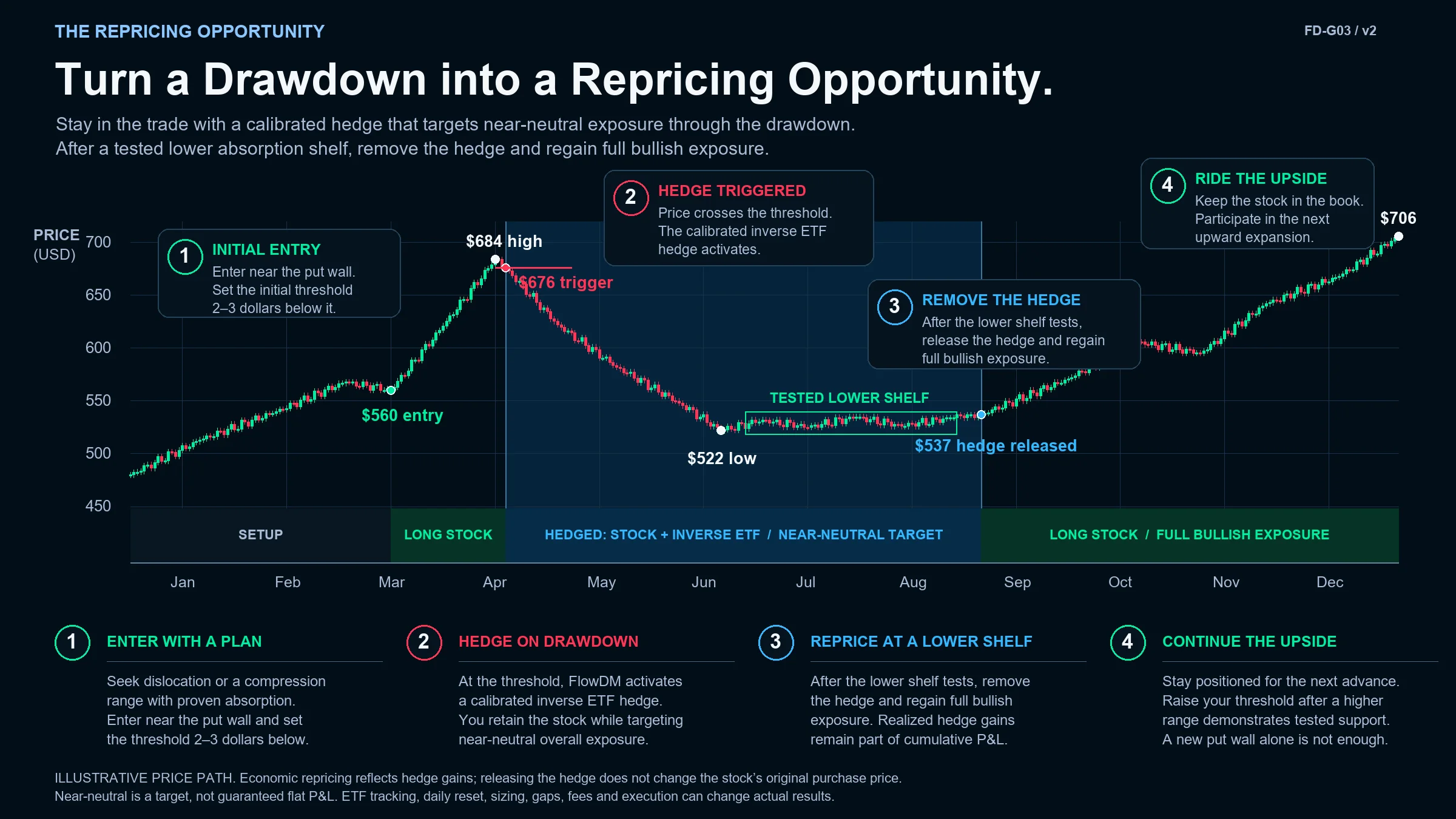
With FlowDM, you may close the inverse leg after a tested lower shelf develops and conditions support that decision. Your original shares can then participate fully if the stock rises again.
Closing the inverse leg may realize hedge gains that remain part of your cumulative position P&L. It does not change the original shares' purchase price or tax cost basis. The result depends on the hedge's performance and the price at which you close it.
You haven't needed to sell the original investment and start over.
The next illustration uses a separate, simplified Meta-inspired price path: a $560 entry, a $684 high, hedge activation at $676, a $522 low, and hedge release at $537 after a lower shelf tests. The recovery shown after release is illustrative, not a record of a completed trade or a forecast.
What If the Stock Doesn't Return to Its Previous High?
A stock doesn't have to return to its former high for a new upward move to create an opportunity.
If you remove protection at a lower price and the stock subsequently advances, your shares can benefit from that move even if the stock never reaches its previous peak.
Repricing can create a new opportunity within an investment you already own.
When a Stock Reverses Unexpectedly
Occasionally, a stock falls just far enough to activate your hedge, then quickly reverses and begins climbing again. We call this a tap-and-go.
Because the position is hedged, you may miss some of the subsequent upside.
You can remain patient and allow a new range to develop, or wait for another pullback toward an area where buyers have demonstrated support. If the stock establishes a higher range with a proven absorption shelf, you may decide to remove the hedge there.
A release at a higher price can produce less favorable hedge results, including a loss on the inverse leg. Not every hedge improves the position's economics.
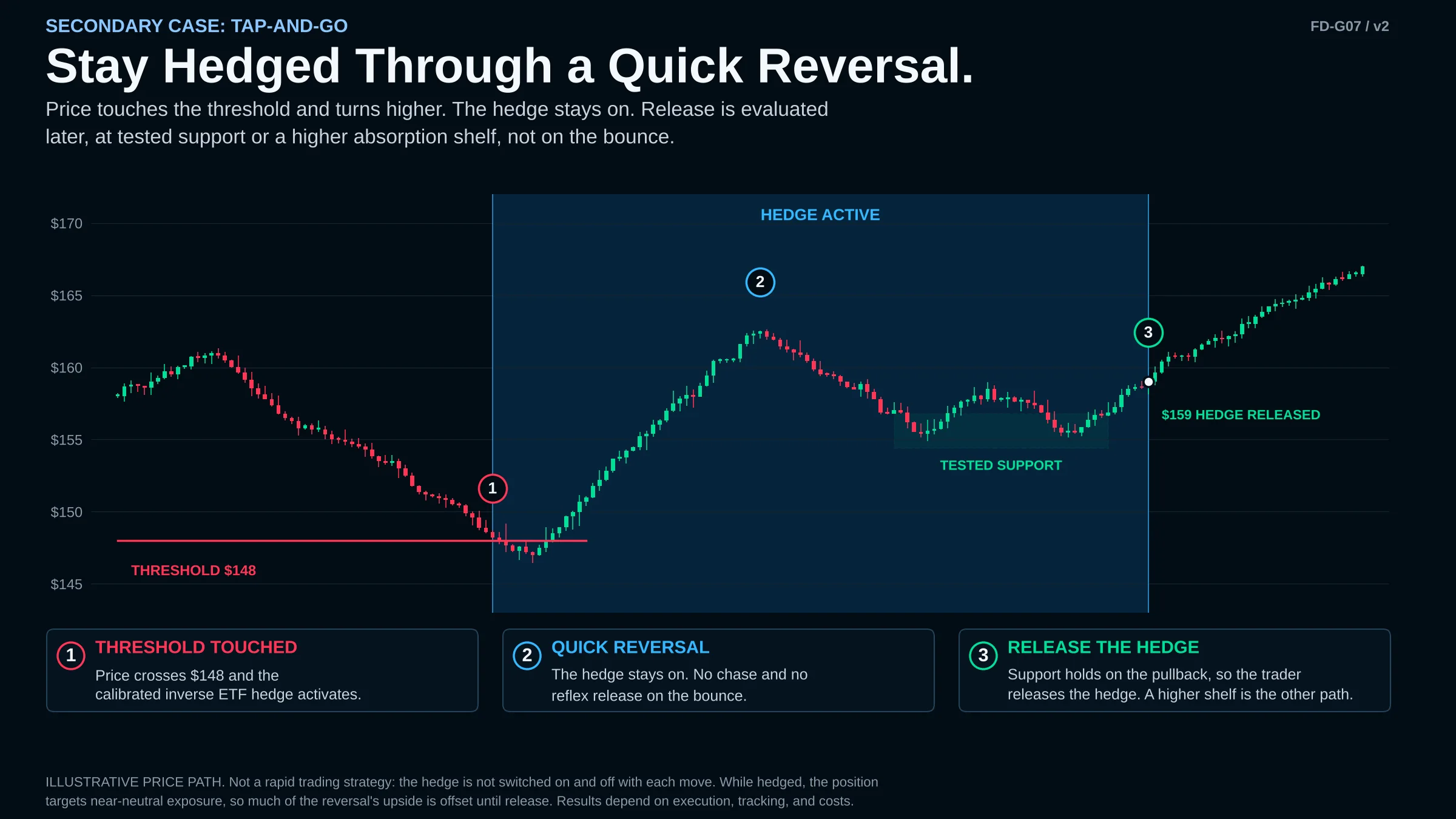
The important thing is not to chase a stock simply because you're frustrated about missing part of its move.
An unexpected reversal presents another position-management decision.